T-34 in Action by Artem Drabkin
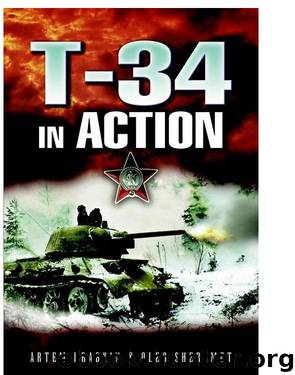
Author:Artem Drabkin [Drabkin, Artem]
Language: eng
Format: epub
ISBN: 9781783460861
Publisher: Penn & Sword Books
Published: 2006-06-19T04:00:00+00:00
and Doroshenko’s skill as a driver, as well as the spikes, did their job.
The engine roared but we slowly crawled up the slope. After reaching the edge of the ravine the tank stopped for a second, but finally it rolled onto to the even surface and Doroshenko started to turn it around. The Germans heard the loud roar of our engine and started to shoot illumination flares into the sky. Their smallarms fire intensified. I looked around, ordered the crew to get into the tank, and we rested for half an hour. I closed the hatch and immediately fell asleep.
Apparently, the same happened to my crew.
Battle near Dashukovka village.
I was woken up by a loud bang on the turret. It was the commander of the 242nd Rifle Regiment. I opened the hatch and introduced myself. He praised me for negotiating such a deep ravine. ‛See those moving lights in the distance?’ he said. ‛Those are German trucks. I think that several German units have already travelled along the road out of the encirclement. I have the remains of my regiment here –
about a company strong. You should use the cover of darkness to support an attack by my infantry. Reach the northern edge of the village and stop German traffic on the road by your fire. The motorised rifle battalion from your brigade is about to arrive, so help is near.’
I could see the small lights of cigarettes twinkling some 200 metres in front of me, where the infantrymen were lying in wet snow. I ordered the driver forward and shouted: ‛Prepare for battle!’ I showed my open palm to the loader: ‛Fragmentation round!’ I stopped the tank some ten metres from the infantry and inspected the line of men lying in the snow. They were mostly armed with rifles and only a few had SMGs. Apparently they’d been scratched together from all the units of the regiment. The line was about 300 – 400 metres long and I estimated there were about fifty men. I peeped out of the hatch and spoke to the infantrymen: ‛Guys, we will now throw the Germans out of the village and reach its opposite edge, where we’ll take up defensive positions. So don’t lose your entrenching tools in the process! Advance in short rushes ahead of the tank, firing at the enemy on the move.
Don’t be afraid of my fire, as I’ll be firing over your heads.’ One infantryman shouted to me: ‛Since when do tanks advance behind infantry?’ I answered that this was a good question but that in this assault we had to act like I said. ‛I’ll be destroying the enemy’s MGs, and when we’re some 200 metres from the village I’ll rush forward and you follow me. Now, look at me and go forward at my order!’ The engine roared. The Germans shot several illumination flares and seven MGs immediately opened fire on us. I set the sight at night-shooting and started destroying them from right to left. My rounds suppressed three or four MGs in the first minute or two. I peeped out of the tank and ordered: ‛Forward!’ The infantry stood up reluctantly, but still started the assault. The enemy again opened fire from four or five MGs. I destroyed three of them and ordered my driver to advance 20 –
30 metres. I fired two rounds at the edge of the village, and then, firing on the move, destroyed another German MG. I could see that my infantry was advancing in short rushes.
The enemy could only return rifle fire. Apparently the Germans had left just a small delaying party of about one rifle platoon in the captured village, without a single AT gun. They must have thrown the rest of their forces into breaking through to the encircled units. A decisive moment came – the infantry now believed in me after seeing how I’d dealt with the MGs, and they continued to advance in short rushes, firing at the enemy. I couldn’t miss this favourable opportunity: I peeped out of the tank and shouted: ‛Great job, guys, now assault!’ I passed the infantry and rushed into the village, firing on the move. I stopped for a second, fired two rounds along the street at the fleeing Germans, and fired a long burst from the MG. I noticed some monster vehicle trying to turn from around the corner into the street. I immediately shouted to Doroshenko: ‛Squash it!’ He threw the tank forward and hit this monster with the right side. It turned out that it was a German six-barrelled mortar.
We continued to drive along the street, killing the Germans who were running out of the huts and milling around their vehicles. Many managed to escape into the ravine, but those that were afraid of the darkness of the ravine and ran along the main street were all killed.
Soon we reached the northern edge of the village and started choosing a good defensive position. A hut stood alone some 200 metres away. I drove to this and parked my tank with its left side towards the wall. I could see lone German vehicles driving along the road some 800
metres from me. The mission was complete – the road was in my gunsight.
My infantrymen started to arrive little by little. Only twenty of them were left. I ordered them to take up an all-round defence and dig in, as the enemy could outflank us through the ravines. But just as I’d feared, the infantrymen didn’t have entrenching tools with them and they all flocked to my tank, seeking protection from it. When I saw this, I told them to spread out and find a good defensive position and be ready to repel the enemy’s counter-attack at dawn. Several minutes later a whole host of lights appeared on the road in front, from behind a grove that was to the left of us. This was a German truck column carrying infantry (the Germans drove with their headlights on during night marches for the entire war). Through my gunsight I estimated their speed at about forty kilometres per hour and waited for them to enter my field of fire. I didn’t expect the Nazis to give me such a gift! I fired at the first truck and turned it into a huge fireball. Then I fired at the last truck (it was the eleventh in the column), and it jumped into the air and fell in pieces. Chaos ensued on the road. A half-track that was the second vehicle in the column tried to pass the burning truck and immediately got stuck in the mud. Other trucks also tried to drive off the road to left and right and also got stuck. The half-track caught fire from my third round, and I continued to fire at intervals of six to eight seconds. Doroshenko shouted to me: ‛Lieutenant, don’t destroy all the trucks, we should get some war booty too!’ ‛All right, got you.’ The fires made it bright as day. I could see the silhouettes of Germans running in panic against the flames of the burning column. I fired several fragmentation rounds at them and emptied a DT MG disc, firing short bursts.
Night gradually gave way to dawn. It was misty and light sleet was falling. The enemy didn’t counter-attack, but instead tried to evacuate their wounded from the battlefield. My infantrymen were frozen to their bones and tried to warm themselves the best they could. Some of them went to seek warmth in the huts at the edge of the village.
My crew didn’t lose their concentration. As experienced troopers, they knew that the Germans would soon try to drive us out of the village. Indeed, a bit later a young soldier walked up to my tank and shouted to me: ‛Comrade Lieutenant, enemy tanks!’ I started to open the hatch in order to look around, but before I could lift my head I felt a bullet hit the hatch lid. A tiny splinter of armour scratched my neck. I closed the hatch and looked in the direction indicated by the young soldier. Two Panzer IV tanks were trying to sneak past our position through a ploughed field on the right, some 1.5 kilometres away. ‛Here they come again.’
I told the infantry and crew to prepare for battle and ordered a fragmentation round to be loaded, as the two tanks were far away and I had to find their range first. The round exploded some five to ten metres from the first tank. It stopped, and I hit its side with the second armour piercing round. The second tank tried to drive away, but I immobilised it with two rounds. One crew member bailed out from the turret and ran away into the field. The 19th of February was beginning well.
I relaxed and was almost punished for this – a bullet hit the edge of my hatch when I lifted it in order to look around. The young soldier who’d pointed out the German tanks came and shouted that some German officers were looking at our position through binoculars from the other side of the ditch. After saying this he turned to walk away but suddenly swayed and dropped to the ground. I looked through the triplex and saw a small stream of blood flowing from the back of his head. I said to my driver: ‛Pete, reverse and drive around the house. Be ready to come back to this spot.’ The tank slowly reversed and emerged from behind the hut. I turned the turret and through the sight saw four men with binoculars lying in the snow some 400 metres from me, right behind the ravine. The group of officers, led by a General whose collar was adorned with fox fur, were inspecting the terrain and my position. Fetisov set the fuse and reported: ‛Fragmentation round, ready!’ I aimed, and the round exploded right in the middle of this group. Immediately I saw at least fifty Germans in snow camouflage running from all sides to rescue the wounded. I then took my revenge for my young infantryman, firing fifteen fragmentation rounds at them.
Having calmed the Germans down in this way, we came back to our previous position on the right side of the hut and awaited their next move.
No one replied to my messages over the radio, and I only had fourteen rounds left, consisting of one armour-piercing, one shaped-charge, and twelve fragmentation rounds. In addition to that, both Elsukov and I had a half-full ammo disc for our DT MGs.
All of a sudden an aircraft emerged from behind the grove that was to the left of us. We dubbed such aircraft ‛Caproni’ at the front. This was an Italian-made aircraft and it could dive very well. It turned around and flew at 50 – 70 metres’ altitude along the ravine to the left from the village, at the spot where I’d destroyed the group of German officers. Doroshenko again drove the tank into its firing position and I started to observe the aircraft. It turned around again and flew towards us. The Germans fired green signal flares and the aircraft responded with a green flare. It turned around again, dropped a large box and flew on.
There was a road perpendicular to the road that we’d closed, with a telegraph line along it. The aircraft was flying back and forth along this line of poles, and as I knew the approximate distance between the poles, I could roughly estimate its speed. It flew quite slowly, 50 – 60
kilometres per hour. After the aircraft dropped its cargo and flew past us, I decided to try and shoot it down if it turned back again. I ordered Fetisov to set the fuse and load a fragmentation round. The aircraft turned around, I aimed and fired. My round hit its engine, and the aircraft broke in two. It was quite a show! Next instant the field was literally swarming with German soldiers who’d been hiding in the snow and now ran to the remains of the aircraft. I forgot that I was short on ammo and shot about ten fragmentation rounds at this mass of Fritzes.
I set the tank back in its previous spot and I remained excited for a long time. I’d seen a lot of things, but shooting down an aircraft !
The radio was still silent, I had enough ammo to destroy two armoured targets and MG ammo enough to repel one platoon-sized infantry attack. The time was ticking. There was complete silence all around us, a silence that promised a quick end of play. I heard one of the infantrymen shouting to me from the ground: ‛Comrade Lieutenant, an assault gun has appeared on the left behind the ravine.’ I ordered Doroshenko: ‛Drive around the hut as you did before.’
We emerged from behind the hut and I saw a German assault gun with its main weapon aimed right at us, but apparently it didn’t have time to get a better aim, as we quickly hid behind the hut. However, that route of retreat was shut. It was clear that the Germans would start their breakout attempt in a matter of a few minutes.
The German assault started head-on, from the road. About 100
infantrymen in white overalls with SMGs advanced openly along the road, firing long bursts. They were just 300 – 400 metres from me. At first I didn’t understand why they acted so boldly. If I’d had ten fragmentation rounds and four or five MG ammo drums I could have calmed them down in a matter of minutes. Then I heard the roar of a heavy German tank engine, a Tiger or a Panther, amid the cacophony of SMG bursts. That’s why they were so bold. They had a heavy tank with them. I shouted to the three or four infantrymen that remained to peep from behind the hut and see what was on the left on the road.
None of them responded.
I made the decision immediately: let the Tiger approach me and kill it head-on with my last armour-piercing round as I suddenly emerged from behind the hut. I said to Doroshenko: ‛Pete, start the engine and don’t shut it. We let the Tiger come closer, jump out from behind the house and when you count four, without my command, you hide behind the hut again.’ The radio operator and I fired a couple of short bursts from the MGs, killing several of the attacking Fritzes.
The noise of the engine was very near. I shouted: ‛Forward!’ We rushed into position and saw the Tiger with tank riders some 150
metres from us. The Tiger had just started moving after a short halt.
This was exactly what I needed. I didn’t wait for my tank to stop bouncing from its sharp stop, I aimed at the German tank and fired. No effect! Petr swiftly drove the tank backwards, and I shouted to Fetisov to load a fragmentation round. Then I saw that the German infantry in the field had stopped. I fired the last fragmentation round at them at point-blank range and saw them flee. We emerged again from behind the hut and were dumbfounded by the view. Flame was slowly enveloping the Tiger. One crewman was hanging dead from the turret.
An explosion sounded in the air. The Nazi tank ceased to exist. We’d won again.
I forgot that I had only one shaped round left, ordered Fetisov to load it and decided to kill the assault gun in a one-on-one duel. Instead of calming down, I went looking for trouble! Petr drove the tank in reverse gear to the left of the house and brought me face to face with the assault gun, that was indeed waiting there for me with its gun aimed. He gave me time to get him into my gunsight, but he fired first, hitting the base of my turret with an armour-piercing round. The round destroyed the pig-iron counterbalances of the gun, killed Fetisov, and got stuck in the back wall of the turret. The second round destroyed the gun mantlet, turned the turret to its side and jammed the hatch. I shouted ‛Bail out!’ and tried to open the jammed hatch with my head. I opened it with great difficulty on the third attempt, pulled myself up, and jumped out of the tank almost at the same moment as the assault gun fired again. My radio operator Elsukov was running some fifteen metres in front of me. I turned back and saw that the Germans, who’d been fleeing a second before, had turned back and renewed their assault. They were just 150 metres from me.
I followed Elsukov towards the nearest buildings, but after running several metres I heard a cry from Petr Doroshenko: ‛Lieutenant, help!’
I turned around and I saw that he was hanging out of the driver’s hatch, caught beneath its lid. I came back to him under fire, pulled the lid upwards, helped him out, and then carried him on my shoulders.
Seven quickly spreading bloodstains could be distinctly seen on his padded jacket. There was a ditch in front of the houses that was under German fire from the other side of the ravine. I was about to jump across it, but when I was two metres away the enemy suddenly ceased fire. Apparently they were changing an ammo belt, and I just stepped over the ditch, still carrying Petr Doroshenko.
I was twenty metres from the last huts of the village when I saw the artillery crews of our motorised rifle battalion rolling two guns into position, preparing for battle, and our men with SMGs forming an assault line. My strength left me and I almost collapsed. The orderly of battalion commander Captain Zinoviev and a female medic ran up to me and took Petr Doroshenko. They took us to the village from which I’d started this battle the day before.
The brigade commander came out to meet me. He hugged and kissed me and said: ‛Thank you, son.’ After that he took me into the hut, where I reported the completion of my mission. After listening to my report, he told me that he was recommending me for the Golden Star of Hero of the Soviet Union; driver Petr Doroshenko for the Order of Lenin; loader Sergeant Fetisov for the Order of the Great Patriotic War 1st Class (posthumously); and radio operator Sergeant Elsukov also for the Order of the Great Patriotic War 1st Class. I should add that this was my second recommendation for the Golden Star, but I only actually received it in 1992!
After taking care of Petr Doroshenko, the medics started to take care of me. The female medic took a small splinter out of my neck. Then she asked me to stand up, but I couldn’t. A sharp pain in my right knee forced me to sit down. They started to take off my long boot but couldn’t because of the pain in my leg. Brigade commander Fedor Andreevich Zhilin said sharply: ‛What are you waiting for? Cut the boot.’ I was wearing the long boots that Petr Tyurin had got for me from the destroyed German column, so I begged them not to destroy such good boots. ‛Just cut them open,’ said Zhilin, ‛I’ll give you my tailor-made officers’ boots that I just received this morning.’ After saying this, he put a pair of excellent leather boots alongside my chair.
Then they cut off the boot and my right trouser leg, and saw that my knee was swollen to almost twice its normal size. Apparently, it had been hit with several splinters. I couldn’t calm down and was shivering with shock. The brigade commander ordered them to give me a vodka shot. I drank half a glass like water and fell asleep soon afterwards.
At nightfall we were sent to the rear. Petr was taken to a hospital for the heavily wounded, while I travelled through several field hospitals and ended up in Tarasha town in a hospital for the lightly wounded.
This hospital was set up in great haste; it was poorly equipped and dirty. Wounded were lying on a dirty floor in the reception room and no one took care of them. I decided to get out of there right away. I got a stick and with its help I made it to the house of one of the girls that I’d met in the suburbs of Lysaya Gora in January, when our tank was knocked out. They looked after me very well, and healed my knee in one week. I completed my treatment at home in Arzamas, as I received a leave from the brigade commander.
In April I came back to the brigade, when its HQ was stationed in Boksha village on the border with Romania. However, the brigade commander was no longer Zhilin but Lieutenant-Colonel Pavlovski, who, it seemed to me, was more interested in arranging concerts than training the men for upcoming battles. The day after my arrival he ordered me to report to him, and after a brief interview, in the presence of his field wife and political officer of the brigade Lieutenant-Colonel Molokanov, he announced: ‛I appoint you commander of my tank and my adjutant officer.’ He’d just arrived at the front, and my Order of the Battle Red Banner (that I received instead of the Golden Star for capturing Kiev) apparently made him very jealous and uneasy. I replied that there was no such office as adjutant of brigade commander and that I’d already been tank commander. If the brigade didn’t need me after a year of service at the front, I continued, and he didn’t consider me deserving of an office of at least platoon leader, I would prefer to ask for a transfer to the reserve. ‛Oh, so you say!’ he exclaimed. ‛Then you can go!’ Jumping forward a bit in time, I can add that this ‛general’ was discharged from his office after his very first battles, but by then he’d managed to get almost the entire brigade destroyed. However, I was no longer in the brigade at that time.
In the morning I was informed that I was to go back to my former 207th Guards Tank Battalion as a tank platoon commander. But when I reached the battalion, I wasn’t happy at all. It turned out that the battalion commander was a Major, a small, old man wearing spectacles, who’d arrived in the battalion from the rear and had no battle experience. This was it, I thought. I was very worried about the future of the brigade. But I suddenly learnt that the brigade was forming a third battalion under Dmitry Aleksandrovich Puzyrev, an experienced tank officer. I asked for a transfer, and thank God, they let me go.
For the whole summer of 1944 we were preparing for the offensive.
We received new tanks, but we didn’t get a single T-34/85: all our tanks were the 76.2 mm version.
One day we were standing in the tank trenches that were dug at the edge of a vineyard. There was a monastery one kilometre in front of us.
All of a sudden a Tiger emerged from behind the monastery. It stopped.
Then another Tiger drove up, and then another. There were a total of
Download
This site does not store any files on its server. We only index and link to content provided by other sites. Please contact the content providers to delete copyright contents if any and email us, we'll remove relevant links or contents immediately.
| Africa | Americas |
| Arctic & Antarctica | Asia |
| Australia & Oceania | Europe |
| Middle East | Russia |
| United States | World |
| Ancient Civilizations | Military |
| Historical Study & Educational Resources |
The Sympathizer by Viet Thanh Nguyen(4446)
The Rape of Nanking by Iris Chang(4262)
World without end by Ken Follett(3512)
Ants Among Elephants by Sujatha Gidla(3495)
Blood and Sand by Alex Von Tunzelmann(3240)
Japanese Design by Patricia J. Graham(3216)
The Queen of Nothing by Holly Black(2658)
City of Djinns: a year in Delhi by William Dalrymple(2580)
India's Ancient Past by R.S. Sharma(2493)
Foreign Devils on the Silk Road: The Search for the Lost Treasures of Central Asia by Peter Hopkirk(2482)
Tokyo by Rob Goss(2464)
Inglorious Empire by Shashi Tharoor(2462)
In Order to Live: A North Korean Girl's Journey to Freedom by Yeonmi Park(2410)
Tokyo Geek's Guide: Manga, Anime, Gaming, Cosplay, Toys, Idols & More - The Ultimate Guide to Japan's Otaku Culture by Simone Gianni(2400)
India's biggest cover-up by Dhar Anuj(2381)
The Great Game: On Secret Service in High Asia by Peter Hopkirk(2371)
Goodbye Madame Butterfly(2286)
Batik by Rudolf Smend(2210)
Living Silence in Burma by Christina Fink(2093)
